Data for 30-10-2007:
Comet '17P' Magnitude= 2.9. Best seen from 17.7h - 6.8h. RA= 3h47m26 Dec=+50°29.0' (J2000) Distance to Sun= 2.46AU Distance to Earth= 1.62AU Elongation=139° hourly motion: dRA=-24.9"/h dDec= 6.5"/h.
Or see the finderchart.


 This is the first attempt to make a picture with longer exposure time. For this picture I used 60 frames of 30 seconds. A total exposure time of 30 minutes! These frames where stacked with deepskystacker. Photoshop was used to enhance the picture of M33. This galaxy is a member of the local group.
 After reading the techniques used bij Jerry Lodriguss I reprecessed mij picture of M8 - The Lagoonnebulae. I am happy with the latest results.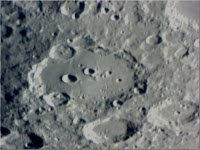
 These two pictures are taken on august the 5th. In the early morning hours the sky was very clear and there wasn't much seeing. And als the collimation of the scope wasn't that bad. So the circumstances were good to make sharp pictures. These photo's of the moon (last quarter) are the sharpest yet. For the photo of the crater Copernicus, I used 3 frames that are combined in photoshop.


 I have been to France for a short holiday. Clear and very dark skies!!! These photo's are my latest results.
 This is the new template that I will use for future Photographs. Besides the actual photo it will also show all the technical data.
 For this photo of the moon I took 2 images: one with a "normal exposure time (1/60 seconds), and one with a longer exposure time (1 second). These pictures where combined to one with photoshop. This will give a total view of the moon.
 This is a mosaic of 5 pictures that I took with the 8" telescope and the Philips Vesta Pro webcam. I used a shutter speed of 1/30 second and took aprox. 600 images. The resulting photo's where stitched together with Photoshop. Click on the image to see "the big picture"...
 While testing my new laptop I resampled my picture of M51 (Canes Venatici). I also detected that two other little galaxy's are visible: IC 4263 (Mvis 15,7) and NGC 5169 (Mvis 14.4). These galaxy's are found at the right hand corner, below the middle. Can you find them? Never before I photographed objects this dimm.
 On this photo you'll see a galaxy edge on (M82) and a galaxy from above. But then again what is up and down in space? I again used 20 pictures of 30 seconds exposuretime at 800 ASA. Notice the fine structure in M81. The spital arm are visible.
 This is also a planetary nebulae. Only this one is green! For this photo I took 20 exposures of 30 seconds at 1600 ASA. These where also stacked with DeepSkyStacker and touched-up with Photoshop.
 Last night we had very clear skies. I went outside at 12 at night, and went to bed at 3:30. But with some result! This is my photo of M27 "the dumbell nebula". I took 20 frames, 1600 ISO, 30 seconds each (10 minutes in total). These frames where stacked with Deepskystacker. In Photoshop the photo was adjusted with curves and contrast/luminosity. It is totaly amasing to get so much detail!. Als the number of stars is fantastic. This is also due to the proximity of the milky way (our own galaxy). I also made an enlargement to show the finer detail inside the nebula. And I also enhanced the colours. I found out that the canon 350D is a little insensetive to red :-(
 This a photo of M57 in detail. Als this photo is touched-up a little with Photoshop. Also the central star, wich exploded and caused this ring of gas, is visible. Look in the centre of the nebulae. Unfortunaly my Canon doesn't record red so well. Otherwise the red outer rimm of the nebulae would be visible also.
 When you're outside a lot you will encouter the odd chance to take a picture like this. I photographed this on april 22.
 This week finaly clear skies again. I had a shot at M13. This is a globular cluster that belongs to our own galaxy. In total I took twenty photo's with an exposion of 1 minute on 800 ASA. These photo's where stacked with DeepSkyStacker. In this case you get a photo with a total exposure time of 20 minutes. After that a little touch-up in Photoshop. For those of you who realy pay attention: In the upper left corner NGC 6207 is also visible. This galaxy has an apparent magnitude of 12,1!
 This is my latest attempt to photograph Saturn. Yesterday we had clear sky's and de seeing was good. Technical data: